Search

News Release Distributed 05/09/08
With hurricane season approaching, it’s a good time to ask yourself a few questions to determine if you’re appropriately prepared, experts with the LSU AgCenter stress.
“Having the right answers before a storm comes your way can help you be prepared if a hurricane strikes,” LSU AgCenter housing specialist Dr. Claudette Reichel advises.
Reichel and LSU disaster education coordinator Pat Skinner also say that even if you’ve been through a hurricane before, it’s easy to forget some of the preparations that can protect your property and family.
“It’s a good idea to review your plans and make sure you haven’t left anything off,” Skinner says, adding, “Taking the right precautions before a storm comes your way has the potential to save time, money, hassles and even lives if a hurricane strikes.”
The LSU AgCenter experts say taking the following hurricane quiz can help you gauge whether you’re prepared. It’s time to take action if you answer “No” or “I don’t know” to any of these 20 questions:
–Do you have a disaster survival plan?
–Have you planned an evacuation route and destination?
–Do you have an emergency communication plan for staying in touch or getting messages to friends and family?
–Is your homeowner's and flood insurance coverage up to date and sufficient to replace your home and belongings if they are damaged or destroyed?
–Do you have an inventory of your property and belongings?
–Do you have copies of your insurance policies, household inventory and other important papers, as well as other valuables, in a safe place – one that’s waterproof and fireproof?
–Do you know how to turn off your utilities (electricity, gas and water)?
–Do you have a plan and supplies on hand to protect and secure your home, outdoor items, boat, pool and so forth?
–Has your roof been inspected within the past six months?
–Have you trimmed the trees and shrubs around your house?
–Has your car been maintained, and are the tires, including the spare, in good condition?
–Do you have a plan of what to do with food in your refrigerator and freezer in the event of a possible power outage?
–Is your emergency phone list up-to-date and handy?
–Do you have emergency survival supplies such as batteries, a battery-operated radio, flashlights, lanterns, fuel, nonperishable food for three days, water jugs, manual can opener, medicines, traveler’s checks or cash, and so forth on hand?
–Do you have an emergency supply kit for your car?
–Do you have a plan of how to take care of family members with special needs (those with disabilities, infants or the elderly) in the event of a disaster?
–Have you decided what you will do with your animals if you must evacuate because of various types of hazards?
–Have you budgeted for the added expenses to protect your home, buy supplies, evacuate, clean up and recover?
–Have you discussed your emergency plans, duties and rules with your family?
–Do you know that the LSU AgCenter offers publications and other free information on disaster cleanup and recovery on its Web site and through its parish LSU AgCenter Extension offices across the state?
“Don’t flirt with disaster for your family or your home,” Skinner cautions. “Get the right answers now, before a major storm heads your way.”
Louisiana residents can buy certain hurricane preparedness items free of sales tax on May 24-25. During the two-day period, the first $1,500 in purchases of certain supplies will be exempt from state sale tax. Visit the Louisiana Department of Revenue’s Web site for more details on the “sales tax holiday.”
For more information on preparing for a disaster or recovering from one, contact your parish LSU AgCenter Extension office.
You also may find the online versions of such publications as “There’s a Hurricane Forming” in the publications section of the LSU AgCenter's Web site. Other resources also are available by visiting Hurricanes on the AgCenter Web site.
###
Contacts:
Claudette Reichel at (225) 578-4440 or [email protected]
Pat Skinner at (225) 578-2910 or [email protected]
Writer:
Tom Merrill at (225) 578-2263 or [email protected]
News Release Distributed 05/16/08
The start of this year’s hurricane season is rapidly approaching, and LSU AgCenter experts say stocking up on supplies now makes sense – whether you think a storm may come your way or not.
“Don’t wait until there’s a storm brewing to get batteries, flashlights, nonperishable food and other things you’ll need if the power goes out,” Dr. Paul Coreil, vice chancellor of the LSU AgCenter, advised. “Start now. It will be a lot easier if you shop for supplies early rather than getting caught up in the last-minute rush at the stores.”
Stocking up isn’t wasteful, according to the experts, who say most of the supplies you need to survive the first few days after a storm are things you can use later if this year’s storm season turns out to be calm.
“We can hope we’re as lucky this year as we’ve been the past couple of years, but we shouldn’t forget what happened in 2005 – with Katrina and Rita,” Coreil said. “People should hope for the best but prepare for the worst.”
LSU AgCenter experts point out you will need a variety of basic supplies just to survive during and after a storm, and depending on the severity of the storm, you may need enough supplies to last several days.
“After a major hurricane, you could be housebound for as much as a week or longer, probably with no electricity,” LSU AgCenter disaster preparedness specialist Pat Skinner said. “Water may be off or contaminated. Stores may be closed. Gas stations may not be in operation. Restaurants may not be open.”
The same types of rules apply if you have to evacuate. You’ll still need some basic supplies, since an evacuation more than likely will mean spending hours in the car and nights away from home.
“Either way, you’ll need some nonperishable food and enough water for everyone,” Skinner said. “You’ll also want to have some other basic supplies, and you can shop for most of those now and store them until they’re needed.”
Some of the supplies you may need include flashlights and extra batteries; hurricane lamps or lanterns (avoid candles); portable radio and extra batteries; first-aid kit or first-aid supplies; insect repellent; matches; ice chest; disposable cups, plates and utensils; disposable towelettes; and prescription medications.
The experts also say you should have at least a three-day supply of food and water for each person. That means at least 2 quarts of water – a gallon is preferable – per person each day. As for food, choose foods that require little or no cooking and no refrigeration, and buy them in sizes appropriate for one meal with no leftovers. You also can keep low-volume, high-energy foods, such as granola bars, raisins and peanut butter, on hand.
“Don’t forget to have a manual can opener. Otherwise, you won’t be able to open canned foods when the power is out,” Skinner cautioned.
LSU AgCenter experts also say to consider any special dietary needs and to be sure to have items such as baby food and diapers on hand, if you need them.
“Keep your pets in mind, too, because they’ll also need to be fed and to have water,” Skinner said.
Although it’s not an absolute necessity, an electrical generator also is something you may want to consider purchasing to meet your emergency power needs. “This is particularly important if you must operate medical equipment continuously,” Skinner said, adding, “It also is a way you can protect your investment in frozen foods, since a generator could allow you to keep your refrigerator and freezer running.”
Camp stoves or barbecue grills also can help with cooking, according to the experts. Just be sure you have enough fuel on hand – and use them outdoors only.
“Most of the items you’ll need have a long shelf life, but they disappear from stores quickly when hurricane warnings are issued,” Skinner said. “That’s why it’s important to gather these supplies now – before a storm is approaching.
“Doing so also allows you to concentrate on the other preparations you’ll need to be making as a storm approaches.”
LSU AgCenter experts point out that while hurricanes Katrina and Rita served as a wake-up call for people who hadn’t really faced the full devastation of a head-on hit by a major hurricane, the mild hurricane seasons in 2006 and 2007 could lead people to think “it won’t happen again.”
But it’s important to heed warnings and to be prepared, the experts say.
“Much of the damage and loss of life associated with hurricanes can be prevented or reduced by planning, preparation and evacuation,” Coreil said. “Planning may save your life or your pet’s life or help you to salvage something else you hold dear.
“At any rate, it definitely will help you to sleep easier through the hurricane season. And it probably will help to reduce damage to your home, help you cope during the storm and help you recover more easily after a storm.”
To help with preparations, Louisiana residents can buy certain hurricane preparedness items free of some sales taxes on May 24-25. During that two-day period, the first $1,500 in purchases of certain supplies will be exempt from state sales tax. Visit the Louisiana Department of Revenue’s Web site at www.revenue.louisiana.gov for more details on the “sales tax holiday.”
For more information on preparing for a disaster or recovering from one, contact your parish LSU AgCenter Extension office.
You also may find the online versions of such publications as “There’s a Hurricane Forming” in the publications section of the LSU AgCenter's Web site at www.lsuagcenter.com. Other resources also are available by visiting the Hazard and Threats section listed under Family and Home on the AgCenter Web site or by going directly to www.lsuagcenter.com/hurricanes.
###
Contact: Pat Skinner at (225) 578-2910 or [email protected]
Writer: Tom Merrill at (225) 578-2263 or [email protected]
News Release Distributed 05/15/08
As hurricane season approaches, it’s a good time to take a few simple steps to protect your home and family in case a storm strikes, according to LSU AgCenter disaster preparedness specialist Pat Skinner.
“Many of the precautions you can take are simple things to do,” Skinner said. “They’re things you can do now to reduce damage if a storm comes your way.”
Among her recommendations for preventive actions you can take now are:
–Trimming dead wood and limbs out of trees.
–Staking young trees so they’ll survive high winds.
–Making a list of things in the yard that need to be brought inside or tied down if a hurricane comes your way.
–Repairing termite damage that might make your home more vulnerable to wind.
–Moving your family photos and important household documents to upper shelves, where shallow flooding would not affect them. The same thing is true for household chemicals.
Skinner says detailed information is available through the LSU AgCenter’s Web site at www.lsuagcenter.com/hurricanes. Among the resources is “There’s a Hurricane Forming,” a helpful publication that includes a hurricane tracking chart and checklists to help you make last-minute decisions about what to take with you if you evacuate, supplies you need to have on hand, preparations you can make if a storm is approaching and much more.
Hurricane-resistant home construction also is featured in a special LSUAgCenter Web section you can reach by going to www.lsuagcenter.com/homebuilding. (Look at information in the Safer, Stronger, Smarter section, as well as useful links in other sections.)
In addition, the LSU AgCenter will open its LaHouse Resource Center in Baton Rouge July 15 – showcasing hurricane-resistant construction and retrofits for homes, as well as a variety of “green” and healthy features. More details on that project can be found at www.lsuagcenter.com/LaHouse.
Hurricane and flood precautions, however, aren’t only a matter of protecting property, the LSU AgCenter expert points out. You also need such things as a plan to keep in touch with family and friends should evacuation be necessary.
“Whether it’s for a hurricane or in response to a terrorist threat or incident, it’s very possible that members of your family will be caught going in different directions and unable to communicate - even with cell phones,” Skinner explained.
“When that happens, you’d like to be able to find one another – sooner, rather than later,” the disaster expert said, adding that the best way to locate one another is to decide in advance that everyone will “report in” to someone outside the disaster area, such as an uncle in Oklahoma or a close friend in Ohio.
“Decide now who the contact person will be, and give everyone the phone number,” Skinner emphasized. “Be sure every member of your family has the emergency contact information with them at all times, and don’t forget to send copies to your child care center or school.”
For additional information about disaster preparedness, contact an extension agent in your parish LSU AgCenter office.
###
Contact: Pat Skinner (225) 578-2910 or [email protected]
Editor: Tom Merrill at (225) 578-2263 or [email protected]
News Release Distributed 05/19/08
Neglecting to make basic preparations could be a decision you heartily regret if a major storm or hurricane comes your way.
That’s a message LSU AgCenter experts are stressing as this year’s hurricane season approaches.
“Many of the areas most vulnerable to hurricanes were hammered so hard in Katrina and Rita that some people could find it easy to say, ‘What good would a flashlight and a few cans of tuna have done?’” said Pat Skinner, disaster recovery and mitigation specialist with the LSU AgCenter. “But looking at it that way really isn’t a good approach.”
As this year’s hurricane season approaches, Skinner is encouraging Louisiana residents to prepare to survive our more typical hurricane season, where you might be stuck in your home, or on the road, for a few days – not weeks or months.
“It just feels bad when you find yourself saying, ‘I wish I had…’ after a disaster strikes,” Skinner said. “The way to avoid that feeling is to be prepared!”
For most Louisiana hurricanes, here are some things the experts say you may want to make sure you do as part of your preparations:
–Put a flashlight in the car.
–Buy some extra batteries.
–Fill some containers with water.
–Keep nonperishable food in the house at all time – or, in other words, make sure you “don’t eat the last three cans of tuna” without quickly replacing them.
–Make sure there is a working battery-operated radio around!
“Most of us know these precautions,” Skinner said. “We’ve seen the emergency supplies lists. But we still manage to get caught short sometimes.”
Stocking up for a storm is even more difficult now, according to Skinner, who points out that tighter credit and soaring gas prices limit the available funds for buying supplies.
“But the sense of failure that comes with not having what we need at the time of a storm just compounds the problems,” she said. “So try stashing one or two preparedness items a week over the next few weeks, and before too long you’ll have what you need.”
Accumulating some of that stash may be a little easier this month, since Louisiana residents can buy certain hurricane preparedness items free of some sales taxes on May 24-25. During the two-day “sales tax holiday,” the first $1,500 in purchases of certain supplies will be exempt from state sale tax. Visit the Louisiana Department of Revenue’s Web site for more details
Skinner also points out there’s much more to preparing your home for a power outage or other problems brought on by a storm than having flashlights, radios, batteries and food and water.
The LSU AgCenter specialist says you can find helpful information on such topics as making emergency preparations or what to do in case of an evacuation, formulating your family’s disaster plans, keeping track of your family, caring for pets, helping children prepare for a storm, safeguarding your home and property and much more in the Hurricanes section of the LSU AgCenter’s Web site.
Among the resources is “There’s a Hurricane Forming,” a helpful publication that includes a hurricane-tracking chart and checklists to help you make last-minute decisions about what to take with you if you evacuate, supplies you need to have on hand, preparations you can make if a storm is approaching and much more.
Hurricane-resistant home construction also is featured in the Rebuilding & Restoration section of the LSUAgCenter Web site. (Look at information in the Safer, Stronger, Smarter section, as well as useful links in other sections.)
For more information on preparing for a disaster or recovering from one, contact your parish LSU AgCenter office.
###
Contact: Pat Skinner (225) 578-2910
Editor: Tom Merrill at (225) 578-2263


News Release Distributed 05/22/08
Wind is the most common and most costly cause of damage to homes and other “light frame structures” in the United States. The 75-mile-per-hour-plus winds experienced in hurricanes put tremendous pressure on the roof, walls and foundation, and windblown debris can significantly increase the damage.
Although some measures, such as trimming trees and making sure your yard is clear of objects that could become flying debris, are things you can do right before a storm to protect your home, LSU AgCenter disaster recovery and mitigation specialist Pat Skinner says homeowners can do other things for more long-term protection.
“Studies completed following hurricanes show that typical light frame structures (stick-built homes) have some weak spots,” Skinner said. “By strengthening these crucial points, you can make your house much safer against wind.”
Among the points of where traditional frame houses are most likely to fail are the roof, exterior doors and windows, garage doors and connections between the wall and the roof and the wall and the foundation.
Gabled roofs
According to Skinner, two types of roofs are common in light frame structures. Those are gabled roofs and hipped roofs. A gabled roof looks like an “A” on the ends, and a hipped roof slopes upward and toward the ridge from all sides of the structure.
Gabled roofs are more vulnerable to wind force. Most gable ends are simple triangular frames set on top of the wall, forming a joint at the level of the ceiling. This joint typically has very little support.
“The gable end wall is pushed and pulled by wind forces and may be pulled completely out of the building if not properly braced,” Skinner explained, adding, “A failed gable end wall causes extensive damage to the structure – allowing the water and wind to go inside.”
Fortunately, installing braces inside the attic can provide the strength necessary to keep the gable end wall in place during hurricanes.
Bracing involves tying several rafters together, tying several ceiling joists together and adding diagonal pieces to strengthen the top and bottom of the gable end. Rafters are tied together by installing 2-by-4 or 2-by-6 “strong backs” between them. A strong back is two pieces of lumber joined with the narrow edge of one piece nailed or screwed to the face of the other piece, and Skinner says ceiling joists can be joined in the same way.
“With these strongbacks in place, the movement of the gable end is resisted by the combined strength of the set of braced rafters and joists, not just by the one rafter the gable end is attached to,” Skinner explained, adding that for rafters at the gable end, you should start about 18 inches from the roof ridge.
The gable end wall itself is braced by running 2-by-4s or 2-by-6s from the top of the gable to a ceiling joist that is the same distance from the gable end as the height of the gable. (If the gable is 10 feet high, above the ceiling, the brace point should be 10 feet in from the gable. This will require a board roughly 14 feet long. Then a second brace – of equal length – is run from the bottom of the gable, where it joins the wall framing, to the roof-rafter, forming an X with the first brace.
Exterior doors and windows
Stopping wind from entering your house is very important, Skinner said, even when that wind is not carrying rain.
“When high winds enter a home, they create an internal pressure that can contribute to the roof being pulled off the home,” she said. “All of the exterior doors and windows should be secured properly.”
Storm shutters are one way to secure the housing envelope. Shutters can be installed over all windows and doors that have glass.
“Shutters provide effective protection,” Skinner said, adding, “Several kinds of shutters and impact-resistant screens are available for homeowners. These include panels made of plywood or other materials, which can be bought for a minimal cost but must be stored when not in use. There also are operable impact-rated colonial and bahama shutters, shutters that roll up and down and shutters that close accordion style.”
Replacing windows and doors with impact-resistant units is another measure homeowners can take to protect their homes. These windows or doors may be more expensive than shutters, but they provide a natural-looking alternative and work when no one is home to install them or make sure they’re closed.
Garage doors
Securing garage doors is another step homeowners can take to protect their homes against wind damage. Garage doors, especially double-wide (two-car) doors, can be very dangerous during high winds. They can be pulled off their tracks as a result of wind pressure. So these doors need to be strengthened to withstand high winds, and the framing around the garage door needs to be “beefed up.”
“Commercial retrofit kits are available for garage doors,” Skinner said. “Installing horizontal braces to the panels, replacing existing hinges with stronger ones and checking the center and end support for wind loads will strengthen your garage door against wind.”
Because of the tremendous forces involved in a larger garage door, however, Skinner advises replacing the door with one that is hurricane-rated, if at all possible, and having it installed professionally.
Connections
Hurricane winds impose three types of forces on a building – uplift, lateral load and shear. Connections between the framing members (rafters and walls) and between the walls and foundation are important for keeping the house “plumb” and for appropriately transferring all the loads to the ground
“Hurricane straps, clips and anchors provide a very effective solution to this problem,” Skinner explained. “Homeowners can use straps to connect the roof rafters to the studs of exterior walls, as well as using them to connect wall studs to the bottom plate (the piece that sits on the slab, in a slab home). Anchors can be added to hold the bottom plate to the slab.
“For homes with a raised-floor foundation, straps can be used to hold the bottom plate or sill to the foundation framing and the framing to the piers or foundation wall,” she added. “Piers may be the weakest point, depending on their construction.”
Skinner said a block pier with reinforcing bars and concrete-filled cells, set on a continuous grade beam is ideal. If this is not achieveable, efforts should be made to anchor the floor framing to the ground.
For more information on home construction and safety, visit www.lsuagcenter.com. You also can learn more about LaHouse, the LSU AgCenter’s Louisiana House – Home and Landscape Resource Center by visiting that site. The LaHouse resource center showcases hurricane-resistant construction, retrofits for homes and a variety of “green” and healthy features, and it’s slated to officially open July 15.
###
Contact:
Pat Skinner at (225) 578-2910 or [email protected]
Writers/Editors:
Denise Attaway at (225) 578-6087 or [email protected]
Tom Merrill at (225) 578-2263 or [email protected]
News You Can Use Distributed 03/25/08
BOSSIER CITY – A soil analysis is the first thing to consider when planting fruit trees, said Dr. Charles Graham, research horticulturist, at the monthly Lunch and Ag Discovery talk at the LSU AgCenter’s Red River Research Station March 18.
Graham began his talk, “Fruit Cocktail from the Home Garden,” emphasizing a soil analysis to indicate whether lime is needed. “Lime before you put the tree in the ground,” Graham said.
Texture is also important because peach trees like sandy soil, for instance, but they don’t like silt or clay.
Drainage is another factor. How quickly will water move through that soil?
Graham suggested digging an 8-inch hole 32 inches deep, filling it with 5 gallons of water and checking the drainage 24 and 48 hours later. “Adequate drainage for a fruit tree is for it to empty in 48 hours,” he said. “If water remains, use raised beds.”
Evaluate the site for surface characteristics. Ask where the water will go when it rains. He said any elevation is better than none.
Graham said surface water is generally better for irrigation than well water. Most fruit trees are sensitive to salts, he said.
“You might have to stake some trees or you may have to cage them,” added Graham. “Deer love young apple trees.”
Another consideration is pollination requirements. Apples, blueberries, Japanese plums, black walnuts, muscadines, pears and pecans need pollinators. Apricots, blackberries and figs do not.
“Lay a plot out,” Graham advised. “You’re not going to remodel your kitchen without plans drawn out. This is a long-term investment. Put some thought into it. It will save you many headaches in the future.”
Don’t plant pecan trees on the lot where they are shading other crops, he said.
###
Contact: Dr. Charles Graham at (318) 797-8034, or [email protected]
Writer: Mary Ann Van Osdell at (318) 741-7430, ext. 1104, or [email protected]
News Release Distributed 05/22/08
LSU AgCenter housing specialist Dr. Claudette Reichel says not to forget the relatively easy steps you can take to protect your home from hurricane damage.
“Although changes like structural reinforcements, installing hurricane shutters or replacing windows with impact-resistant glass require more time, money and planning, there are some things you can do at a lower cost and with less effort,” Reichel advises.
Pointing out that the biggest risk to homes away from the coast if flying debris, Reichel says picking up items from your yard if a storm approaches is a good first step.
“Hurricane winds can turn loose items into missiles that cause damage or injury to anything or anyone they strike,” Reichel says. “If a limb or a lawn chair propelled by 100-mile-per-hour winds break a window or smash through your roof, the damage then is complicated by rain and wind that rush into your home.
“The damage that follows sometimes is even more devastating,” she adds.
Reichel offers these tips for preparations you can complete yourself to protect your home:
– Make a list of items to bring inside in the event of a storm. Then use that checklist to help you remember anything that can be broken or picked up by strong winds, and make sure those items are brought inside or secured before a storm hits.
– Check your yard for debris, and keep it picked up. Hurricane winds can pick up anything that’s not secured, and even trash and debris can cause damage to things they hit.
– Keep trees and shrubbery trimmed. Make trees more wind resistant by removing diseased or damaged limbs. Also, strategically remove branches so wind can blow through. You may need the help of a license arborist to complete big jobs, and it’s important these chores are done well in advance of a storm, so you don’t have piles of debris or trimmings lying around.
– Clear clogged rain gutters and downspouts, and make sure none of them are loose. Hurricanes often bring long periods of heavy rain. Providing clear drainage will help prevent flooding that could result if water can’t run off.
– If you don’t have impact-rated hurricane shutters, cut half-inch-thick plywood panels to span each opening (well in advance, if possible), buy long mounting screws or specialty hardware and drill the mounting holes into framing (not just in trim or brick veneer) in advance, so you can cover the windows and doors quickly. Be sure to mark which board fits which window to save time, too.
– Keep in mind that tape does not prevent windows from breaking. Taping windows is not recommended and really can just take critical time from more effective preparedness measures. The only thing tape might do is to help reduce the scattering of broken glass.
Reichel also stresses that it’s important to buy the supplies you’ll need well ahead of time.
“Well ahead of time, buy the items you’ll need to board up windows, tie things down and take other measures to protect your home,” she says. “When a hurricane threatens, supplies are quickly sold out at many stores – and the stock generally may not be replenished until after the storm.”
To learn more about preparing for storms and other topics related to home and family life, as well as a variety of other topics, visit www.lsuagcenter.com.
You also can learn much more about LaHouse – the LSU AgCenter’s demonstration home and resource center showcasing hurricane-resistant construction, retrofits for homes and a variety of “green” and healthy features – at www.lsuagcenter.com/LaHouse. The grand opening for that facility is slated for July 15.
###
Contact: Claudette Reichel at (225) 578-4440 or [email protected]
Writer: Tom Merrill at (225) 578-2263 or [email protected]

Get It Growing News for 12/28/2007
By Dan Gill
LSU AgCenter Horticulturist
The basic techniques of gardening today are not that much different than those our great grandparents used. Still, technology and the age of communication are definitely changing the way we live, work and garden. Gardeners will, with greater ease and frequency than ever before, exchange ideas and be exposed to new concepts about how and why we garden. How will the new trends affect the plants we use and how we design with them and care for them?
I think more gardeners will become increasingly sophisticated and knowledgeable and will move beyond some of the traditional ideas about landscape design and maintenance. Outdoor living is becoming a primary focus. Our gardens are more often being looked at as an extension of our homes – an area to live in and use – rather than a just pretty planting to look at.
Designing private, intimate spaces into the average American landscape is becoming more important as our fast-paced world creates an ever greater need for places to relax and enjoy a little quiet time. Private outdoor living areas can be fashioned out of hedges and screens as outdoor garden rooms to give a sense of enclosure and separation from the world.
In addition, accessories that help personalize and enhance landscapes are becoming more popular and will continue to do so. Examples include wind chimes, sculptures and other art suitable for outdoor display, gazing globes, topiary, gazebos, arbors, decorative containers and other accents to individualize our outdoor spaces.
New garden designs are increasingly interactive. We crave gardens that appeal to all of our senses – sight, sound, smell, touch and even taste – with an emphasis on personal enjoyment and the therapeutic values of gardening. An example would be creating a garden that includes a variety of fragrant plants you remember from your childhood.
Water provides sparkling light, beautiful reflections and a most relaxing sound in the garden. Regardless of the garden’s size, we are more and more frequently enhancing the composition by adding a water feature – such as a fountain, reflection pool, waterfall or water garden – that can range in size from a half barrel to a large pond.
The “flower power” generation has brought to gardening a deeper understanding and appreciation of ecology and a respect for natural environments. An increased interest in the use of native plant materials is a reflection of this. Please do not become a “native plant snob,” however, and go so far as to consider the use of any introduced plants as somehow inappropriate. On the other hand, increasing concerns for the tiny percentage of introduced plants that become invasive weeds will influence what we choose to plant.
Realizing the amount of water and energy our landscapes can use, gardeners are switching from plants that need frequent watering and maintenance to those that require less irrigation and maintenance once the plants have become established. Smaller turf areas, low-volume irrigation systems, mulching and low-input plant care are important components of these energy-efficient landscapes. An example might be replacing a traditional high-maintenance lawn area with ground covers and easily maintained decks, terraces and patios of wood, brick, paving or stone.
Gardeners are composting and recycling more, using less fertilizer and choosing environmentally friendly products for dealing with pests. Pest control now tends towards the concepts of integrated pest management, where many strategies are employed (especially using plants that are less prone to problems) to manage pests; and pesticides – whether organic or chemical – are applied only when absolutely necessary. It’s also appropriate to accept some level of pest damage to landscape plants. There is no reason, in most circumstances, to immediately treat with pesticides to deal with minor or non-life-threatening damage.
Many of us have decided it is okay to share our gardens with other creatures, and even create habitats to provide for their needs. Landscapes designed to attract and provide food, water and shelter for wildlife such as butterflies, birds, beneficial insects and natural predators have, and likely will continue to, become more commonplace.
It is remarkable that gardeners “on the cutting edge” are not only looking for new and interesting plants and cultivars but also continuing to focus much of their attention on rediscovering or preserving our garden heritage. Antique roses, heirloom annuals, perennials, vegetables and bulbs and other tried-and-true, old-fashioned garden plants have gained new interest and use. On the other hand, plant exploration is back, and explorers are finding new species of common garden plants to expand and revitalize our plant palette.
Overall, our concept of gardens and landscapes is becoming more personal, interactive and relaxed. Landscapes may still include formal elements, but large turf areas, monotonous pruned shrubs, clipped hedges, foundation plantings and precise annual beds are likely to become less common. A more diverse palette of plants, both native and introduced, will be used in a way that is more resource-efficient and lower in maintenance to create beautiful, functional landscapes that nurture both nature and people.
Get It Growing is a weekly feature on home lawn and garden topics prepared by experts in the LSU AgCenter. For more information on such topics, contact your parish LSU AgCenter Extension office or visit our Web site at www.lsuagcenter.com. A wide range of publications and a variety of other resources are available.
###
Contact: Dan Gill at (225) 578-2222 or [email protected]
Editor: Rick Bogren at (225) 578-2263 or [email protected]
News Release Distributed 05/30/08
Packing a box you can “grab and go” in case you need to evacuate could save you from financial disasters and hardships, according to LSU AgCenter family economist Dr. Jeanette Tucker.
“You may not be able to prevent hurricanes and storms that interrupt your routine or destroy your home, but you can make plans to keep them from disrupting everything,” Tucker says. “An ‘evacuation box’ that’s ready to ‘grab and go’ is one item every household should have to prevent financial disasters and other hardships.”
Calling it a “grab-and-go box,” for short, Tucker says it actually can be a plastic tub, a file box, a backpack or any other durable container you would like – although she says a fireproof and waterproof box or a waterproof backpack are recommended.
“The contents really are the important part,” she says, adding, “Just put it all in something that’s easy to store and easy to take with you, and make sure it’s something that will hold up and help to protect the valuable items you have inside.”
The LSU AgCenter expert says the contents should include copies of important papers, emergency cash or traveler’s checks, lists of emergency phone numbers, safe deposit box keys and backups of computer records. It should always be packed and ready to “grab and go” in case you need to evacuate, she says.
“After hurricanes Katrina and Rita, people around here have a renewed sense of why it’s important for every family and every individual to have evacuation plans in place,” Tucker says. “Although everyone’s emergency plans may be a little different, there are a lot of common elements – and some sort of evacuation ‘to go’ box should be one of those elements.”
Tucker says to keep the “box” somewhere in your home where you can get to it easily.
“Then if you must evacuate, keep the box with you at all times,” she says.
Among the items you’ll probably want to include are:
–Cash or traveler’s checks to cover several days’ living expenses, since power outages can make ATMs and debit cards useless.
–Rolls of quarters for vending machines, pay phones, coin laundries and other needs.
–Emergency phone numbers, including those to doctors, pharmacies, financial advisers, clergy, repair contractors and family members. Don’t forget to include cell phones of those who also may be away from home!
–Copies of prescriptions for medicines and eyeglasses, copies of children’s immunization records and copies of medical, dental and prescription insurance cards (or policy information).
–Copies of auto, flood, renter’s and/or homeowner’s insurance policies (or at least the policy numbers) as well as contact information for your local agents and the companies’ headquarters.
–Copies of other important papers such as deeds, titles, wills, trust documents, powers of attorney, health care directives, stock and bond certificates, recent investment statements, home inventory, birth certificates, death certificates, adoption certificates, marriage certificates, passports and/or other identity documents, employee benefit documents and federal and state tax returns (at least the first two pages).
–Backup copies of computerized financial records.
–Keys to safe deposit box.
–Combination to safe (if you have one).
–Negatives or digital copies of irreplaceable personal photos.
–Computer user names and passwords.
–Lists of Social Security numbers, credit card numbers, bank account numbers, driver’s license numbers, loan numbers, investment account numbers and any other important numbers.
–List of debt obligations, due dates of payments and contact information for companies.
Tucker says it’s also a good idea to place papers in sealed, waterproof plastic bags.
“Some planning and a few relatively simple preparations can prevent the unexpected from becoming even more disastrous,” Tucker says.
For additional information about family financial matters or preparing for storms and hurricanes, contact your parish LSU AgCenter Extension office or visit www.lsuagcenter.com.
###
Contact: Jeanette Tucker at (225) 578-5398 or [email protected]
Writer: Tom Merrill at (225) 578-2263 or [email protected]

News Release Distributed 05/27/08
LSU AgCenter horticulturist Dan Gill says your lawn and landscape should be one area you pay close attention to while deciding whether you’re prepared if a storm comes your way this summer.
“June marks the beginning of hurricane season, and it’s important to understand powerful hurricanes can affect the entire state – not just the southern portions,” Gill says.
Although we’ve had a couple of relatively mild hurricane seasons since the big ones – hurricanes Katrina and Rita – struck Louisiana in 2005, Gill says he still thinks people are “taking recommendations to prepare for storms far more seriously that they may have in the past.”
But some people still forget about preparing their landscape for storms, he says.
“People make all sorts of plans for their home, the pets, their families and whatnot, but they don’t always think about the landscape,” Gill explains. “As you make your plans, remember there are things that need to be done to prepare a landscape for the possibility of storms and things to do when a storm threatens.”
Check trees early on
One of the big things to do now is to check trees and determine if they need to be trimmed or taken out.
“Trees with trunks that show significant decay and threaten a home or other important structure should be removed,” Gill advises. “Trees that are leaning significantly also should be evaluated for possible removal.
“Remember, too, that large trees can impact more than just your property, so you should consider how your trees might affect neighboring properties as well as your own.”
In addition, look for branches that hang over the house near the roof, he says, adding, “Although the branches may not be touching the roof under normal conditions, the high winds of violent storms or hurricanes can cause trees to bend and branches to flail around considerably.”
Since that could cause extensive damage to the roof, such branches generally should be removed.
The LSU AgCenter horticulturist says it normally is best to have this kind of work done by a professional – a licensed arborist – who has the training and tools to do it right. “You may be able to do some smaller jobs yourself, but taking out big trees or trimming larger branches probably should be left to the professionals,” he says.
Another thing to consider is staking young trees – those planted in the past few years – since they can be easily blown over by high winds. “This will save work straightening and supporting them after a storm if it does blow them over,” Gill says.
Then right before the storm
While those are some of the things to do well before a storm, you also need to take action in your lawn and landscape if a storm is approaching.
“If it looks like a hurricane is likely to head your way, secure loose objects in the landscape,” the horticulturist advises. “Look around your grounds for container plants, hanging baskets, tools, lawn furniture (including porch swings), toys, bicycles, bird feeders, wind chimes, barbecue grills, playhouses and doghouses.
“These items can become destructive missiles during high winds and should be stored indoors – in garages or sheds – or anchored securely in place,” he stresses.
If you are the organized sort, you can make a list well before a hurricane threatens of things that need to be brought inside and where you plan to put them – as well as a list of things that need to be tied down outside.
“Buy the necessary equipment, including the anchors or tie-downs, now,” Gill says.
You also need to estimate how long it will take to secure things and make that time part of your family’s emergency plan.
Other points the LSU AgCenter horticulturist says to consider about your lawn and grounds are:
– Pesticides and motor fuels should be stored in areas that are secure and higher than potential flood waters. These products can be hazardous if flood waters spread them through your home or garage.
– If you have a vegetable garden, harvest all vegetables that you can before a storm hits to get them out of harm’s way. There will likely be little left if high winds occur, and produce covered by flood water will have to be discarded.
– Aquatic gardens also need some attention if a storm is approaching. Aquatic plants in pots are often set on bricks, cinder blocks and other supports to boost them to the proper level in the pond. These potted plants should all be set on the bottom of the pond until the hurricane passes. You also may want to consider bringing valuable fish, such as expensive koi, inside in a large bucket of water dipped from the pond to protect them.
– Fountains should be turned off and secured, and electrical cords should be unplugged, rolled up and secured.
– If preparing to evacuate and time permits, be sure to water your indoor plants before you leave.
“As you make your plans for how to get ready for an approaching hurricane, prioritize what you need to do so important tasks are done first,” Gill says. “If your area is put under a hurricane watch, begin to do what is needed to prepare your landscape for the storm.”
The LSU AgCenter expert says to keep in mind you won’t have time to focus on your landscape once a hurricane warning is announced, and you certainly won’t have time for it if evacuations are called for.
For excellent free information on preparing for storms and dealing with the aftermath of a hurricane, contact your parish’s LSU AgCenter Extension office or visit www.lsuagcenter.com.
###
Contact: Dan Gill at (225) 578-2222 or [email protected]
Editor: Tom Merrill at (225) 578-2263 or [email protected]

News Release Distributed 05/26/08
If your family has a plan for what you’d do in case of a hurricane or other disaster, now is the time to pull it out and review it. If you don’t, there’s still time to write your plan, LSU AgCenter disaster preparedness specialist Pat Skinner says.
“The chaos that came in the wake of hurricanes Katrina and Rita demonstrated the need for families to have basic plans for what to do in case of a storm or any other emergency,” Skinner said. “The nation saw families separated and people who didn’t know where they’d go next or what to do.”
LSU AgCenter experts say making plans for emergencies isn’t complicated, but they need to be made well before a disaster strikes.
“That ensures everyone has a better chance of knowing what to when an emergency comes along,” Skinner says.
The start of hurricane season is a good time to review your existing plans and update them – or to make plans if you’ve never done so before.
“Although having a family emergency plan won’t stop the destruction or devastation that may come from a major storm, such plans can help to reduce your losses and to help you and your family cope better with the aftermath,” Skinner says. “They also may help you stay together throughout it all.”
Experts say emergency plans should address basic issues such as these:
–Know the emergency broadcast station frequency for your area, so you can keep up with the latest news bulletins.
–Map out where you would meet and who you would call if you were separated from other family members in an emergency.
–Think about measures you need to take to protect your home and property. Are there things you can do well in advance, such as trimming trees to prepare for a storm? And what will you need to do at the last minute, such as turning off utilities, securing loose items or covering windows?
–Make sure you have basic emergency supplies, such as a battery-powered radio, flashlights, batteries, a first-aid kit and so forth.
–Keep at least a three-day supply of nonperishable food on hand and devise a means of storing ample water for that time frame, in case you need it.
–Consider if there is someone you would tell if you decided to leave home in an emergency (neighbors, out-of-town relatives or others). Doing this also gives family members someone else to contact about your status if they can’t get in touch with you.
–Where would you go if you needed to evacuate? Would you go to a shelter? Do you have out-of-town friends or relatives who could house you? Remember, hotel rooms are difficult to find during an emergency.
–What route would you take during an evacuation? Do you have a car, and would you drive? Would you need to depend on public transportation, and if so, will it be available? Check with your area’s emergency manager for information on your community’s evacuation plans.
–What would you take with you if you had to evacuate? You’ll definitely need to have identification, some cash, copies of important papers, medications you take regularly, clothing for at least a few days and other necessities for daily living. You also might want to take copies of a few family photos or other sentimental items you could reasonably transport.
–How will you provide for your pets’ care and safety? Will you take them with you if you evacuate? Can you provide them with plenty of food and shelter if they must be left behind?
“You need to make sure everyone in the family knows the basic parts of your plan, so it’s definitely a good idea to write it down and share it with those in your household and others who may be concerned about you,” Skinner advises.
“A written plan also can serve as a checklist for you, so you’ll want to keep it someplace where you can find it in a hurry,” she says. “After all, emergencies tend to be a time when people get excited and may forget what needs to be done. If you have a plan, it helps smooth things out a little.”
For more information on preparing for emergencies, visit www.lsuagcenter.com and search for keywords like family safety, hurricane preparedness and storm news.
###
Contact: Pat Skinner at (225) 578-2910 or [email protected]
Writer: Tom Merrill at (225) 578-2263 or [email protected]
News Release Distributed 05/29/08
Everyone will be able to cope better if you talk to your children early about hurricanes and get them involved in your plans and preparations, says LSU AgCenter family development specialist Dr. Diane Sasser.
“Don’t wait until a storm is approaching to talk to your children about hurricanes,” Sasser stresses. “The best thing is for parents to start explaining things to children long before hurricane season begins.
“But it’s never too late to explain what hurricanes are, the dangers they pose and the safety measures to take against them,” she adds.
The LSU AgCenter specialist says those types of discussions can help to alleviate some of the fear and anxiety children and adults feel when a storm is approaching.
“Helping your children learn all they can about storms can help them – and it may even help parents, too, if they learn something, as well,” Sasser advises.
Making plans and practicing what the family will do if a storm approaches can help everyone mentally and emotionally prepare for a storm, according to the expert.
“Consider how your children might react during a disaster and what your reactions might be,” she says. “Then work out a plan in advance on how to deal with these situations.
“Families who work together to prepare for a hurricane will cope better than those who do not take precautions,” Sasser stresses.
Although we’ve had a couple of relatively mild hurricane seasons, the LSU AgCenter expert points out that an approaching storm still could bring back memories of the devastation of hurricanes Katrina and Rita in 2005.
“Most children already have a negative reaction to the threat of a hurricane, and that could be even worse if they think back to those major hurricanes,” Sasser says. “But the good news is that you can help diminish those reactions if you help children prepare for what might be coming.”
The LSU AgCenter family life specialist also offers this advice on how children respond to stress and ways you can help them cope during the hurricane season:
–Try to keep children as close to their daily routine as possible. Routine is what gives children security and helps them feel things are normal. Give them exact steps to follow whether you’re practicing what you’d do if a storm was coming or actually preparing for a real one.
–Talking, practicing and preparing together can help kids understand a disruptive occurrence like a hurricane. Give children clear information on what is happening and what could happen (within reason and considering their age). Knowing that you understand the situation will ease their feelings.
–Before the storm, you should have designated a safe place in your home for your family. Go to the safe place with your children as practice. Show them where the “safe place” is. Discuss emergency weather plans with children, including what to do if the children are home alone or if the family is separated.
–Consider organizing important family papers and pictures. Being able to grab a picture or document box if you are evacuating or moving to a safe place may help preserve family history or treasures and protect important documents. Think about storing duplicate photos or negatives in an alternate location such as a bank safe deposit box or at a relative’s home.
–Teach your child how to recognize danger signals. Explain that a hurricane is a giant, rainy windstorm. Tell them it can be dangerous and destructive, but that with some preparation (or evacuation), it is survivable. Keep it simple. But remember the more they know, the safer they will be.
–Explain what safety measures you have taken to protect your children and your home.
–Make sure children understand it is important to listen carefully during emergency situation. They should know that adults will be trying to help them, and they should listen to explanations and safety instructions.
–Reading also can provide some awareness and mental preparation. News stories of community disasters can create opportunities to discuss ways your family might handle a similar situation. This gives kids time to think about and create a plan of action for real-life disasters. Talking about alternatives also may encourage children to act responsibly, rather than react.
–Remember that children need to talk about their anxieties. This process of talking will help them work out their feelings. Take your children's feelings seriously and reassure them often. Be patient with them.
–Younger children need to work out their fears while playing. Try to help them through this process with comments like, “That tower made a lot of noise when it fell down, didn't it?” or “That baby is sad, isn't she?”
–Explain how to call for help. Teach your child how and when to call for help. Check the telephone directory for local emergency phone numbers and post these phone numbers by all telephones. If you live in a 911 service area, tell your child to call 911.
–Help your child memorize important family information. Children should memorize their family name, address and phone number. They also should know where to meet in case of an emergency. Some children may not be old enough to memorize the information. They could carry a small index card that lists emergency information to give to an adult or babysitter.
–Involve your children in the family's hurricane preparation. Also, allow your child to have his or her own flashlight to give him or her a sense of control. A hurricane supply list for children should include games and toys, a favorite blanket or stuffed animal and your children's favorite food or snack.
–Develop and practice a family disaster plan. Contact your local emergency management or civil defense office, or your local Red Cross chapter for materials that describe how your family can create a disaster plan. Everyone in the household, including children, should play a part in the family’s response and recovery efforts.
–Assemble a family emergency kit. Include a flashlight with fresh batteries; battery-powered radio; blankets or sleeping bags; first-aid kit; candle and matches; nonperishable food, such as granola or cereal bars, crackers and pull-top canned food items. (If using traditional cans, be sure to include a nonelectric can opener.) Must-have medications also should be included in an emergency kit.
“The more your children are involved the better they’ll feel in the long run,” Sasser concludes. “Start talking to them now. You won’t regret it.”
For more information on family life, storm preparation and a variety of other topics, visit www.lsuagcenter.com.
###
Contact: Diane Sasser at (225) 578-4448 or [email protected]
Writer: Tom Merrill at (225) 578-2263 or [email protected]

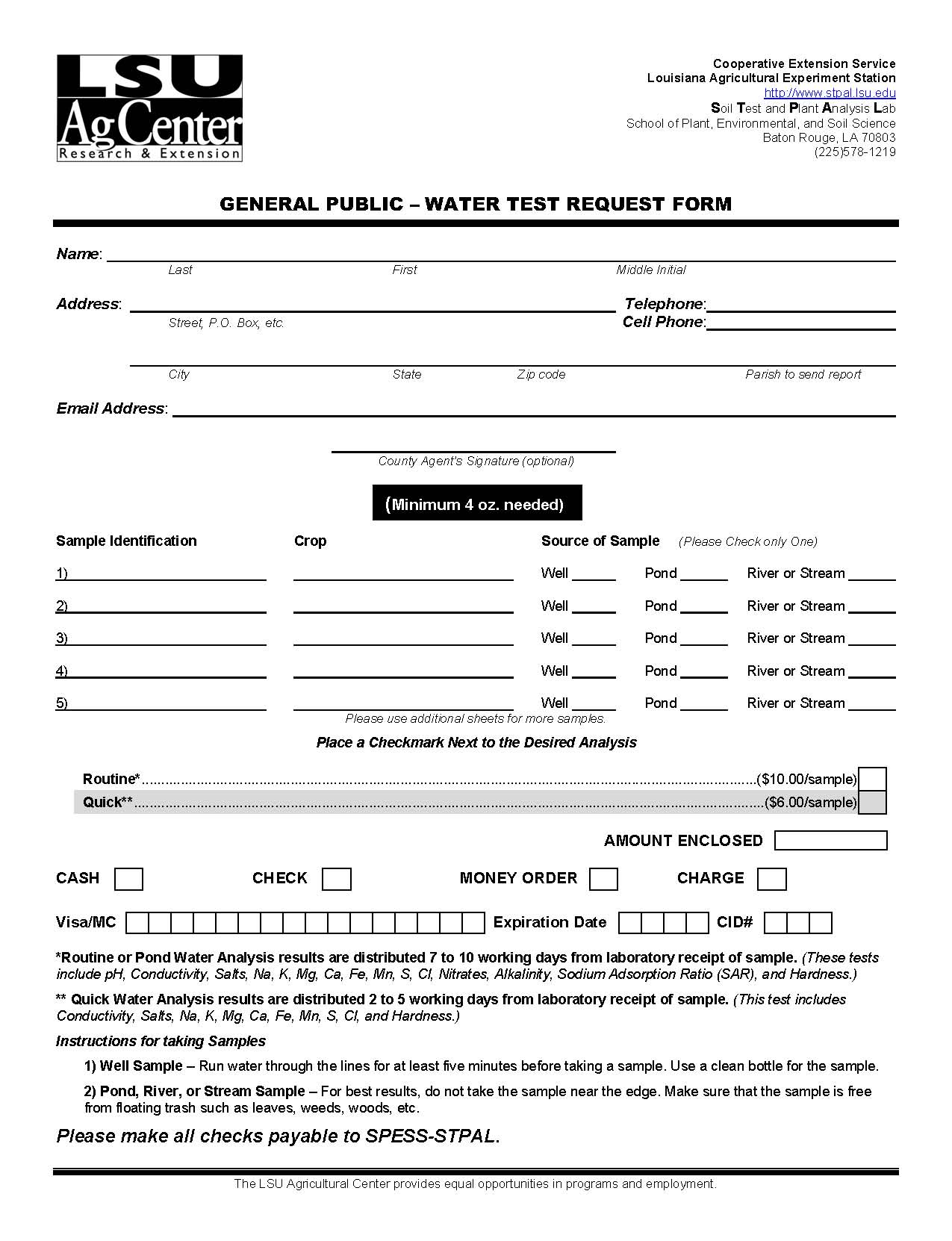
This test is used for agriculture or aquaculture purposes. Use a clean bottle for the sample. For a well sample, run water through the lines for at least five minutes before taking the sample. For pond, river or stream sample, do not take a sample near the edge. Make sure the sample is free from floating trash such as leaves, weeds, etc. Use the Water Test Request Form.


 1105084HFuture | 947.75KB
 111708CoolseasonPlants | 950.20KB
 Callegari_brochure1 | 2.20MB
 110508DelayDiabetes | 943.26KB
 110408FallingLeaves | 908.57KB
 110508FriedTurkey | 945.31KB

 111108Lettuce | 930.61KB
 110508CookingTurkey1 | 943.26KB
 110608Chrysanthemums | 925.71KB
 110508ThawingTurkey | 939.18KB
 SmartBodies384K_Stream | 4.66MB
 SmartBodies56K_Dial_Up_Stream | 645.98KB
 1105084HCentennial | 949.80KB

 111008Perennials | 941.63KB
 102208FireAnts | 943.26KB
 102208FireAnts | 943.26KB

 111808SummerBulbs | 946.53KB
